How to play:
1. Piece
assignment – before the game begins, the players will decide who will be as=
signed
as the positive and negative player. The positive player receives credit for
algebraic operations that result in positive values, while the negative pla=
yer
receives credit for algebraic operations that result in negative values.
2. Pieces
Movement – moving is initiated by a player as signed as positive and taking
turns alternately with negative player. The players move their respective
pieces towards the place of the opposing piece one square at a time moving
forward, diagonal, or sideward. Backward move is not allowed. The movement
creates an opportunity for the opposing pieces to operate, score, goal and =
win
the game.
3. Algebraic
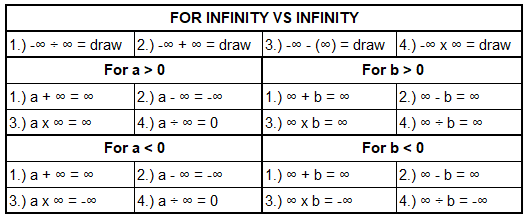
operation – algebraic operation happens in the operating process. Operating=
is
done by placing an offensive piece on top of the adjacent defensive piece’s
position thereby creating an overlap. Following the binary operation in the
form A * B =3D C, A takes the value of the defen=
sive
piece, the piece on top, * is the operation indicated on the square, B is t=
he
offensive piece, the piece on the bottom, =3D is the equation symbol and C =
is the
result of the operation. The result of the operation C is computed following
the rules in algebraic operation.
Game Pieces:
The set of pieces for each player include 1 zero, 2 inf=
inity pieces, 6 positive inte=
gers,
6 negative integers.
Scoring and capturing:
Scoring is the giving of edit points to the player base=
d on
the result of the operation. An operation resulting to a positive value wil=
l be
credited to the positive player with the absolute value as credited as a sc=
ore.
An operation resulting in negati=
ve
value will be credited to the assigned negative player. The piece of the pl=
ayer
who scored stays automatically captures the opposing piece and the captured
piece is taken out of the board.
Binary operation resulting to positive answer will be
credited to positive player and the negative player gets for negative answe=
rs.
No player can get credit for zero answers and both pieces will be taken out=
of
the board.
For division operation, a positive integer piece divide=
d by
zero will result to positive infinity. In this case, the positive player get
the credit then convert his piece into infinity and the losing piece will be
taken out. If a negative integer piece is divided by zero, the result is
negative infinity then the negative player converts his piece to infinity a=
nd
the losing piece will be taken out. In this case, the player will have two
infinity pieces on board providing an added life to the player.
Both players have positive value infinity pieces. An
infinity piece involved in an operation is captured when the result is a
negative value, zero or DNE. A player with no more infinity piece losses the
game.
Winning the game:
There
are four (4) ways in winning the game.
1. Capturing
the infinity piece.
2. Going
for an infinity goal.
3. Getting
more score. (this happens if both losses their infinity pieces at the same =
time
during infinity encounter).
4. Time
limit
Goaling=
is
the process of taking the player’s infinity piece to its assigned goal foun=
d at
the opposite end row on the opponent’s side. If one of the players reaches =
its
infinity goal or if one of the players loses its infinity piece, a winner w=
ill
be declared. If both players lose their infinity pieces at the same time, t=
he
player with the higher score wins, and if one player is running out of time=
he
or she loses the game.